
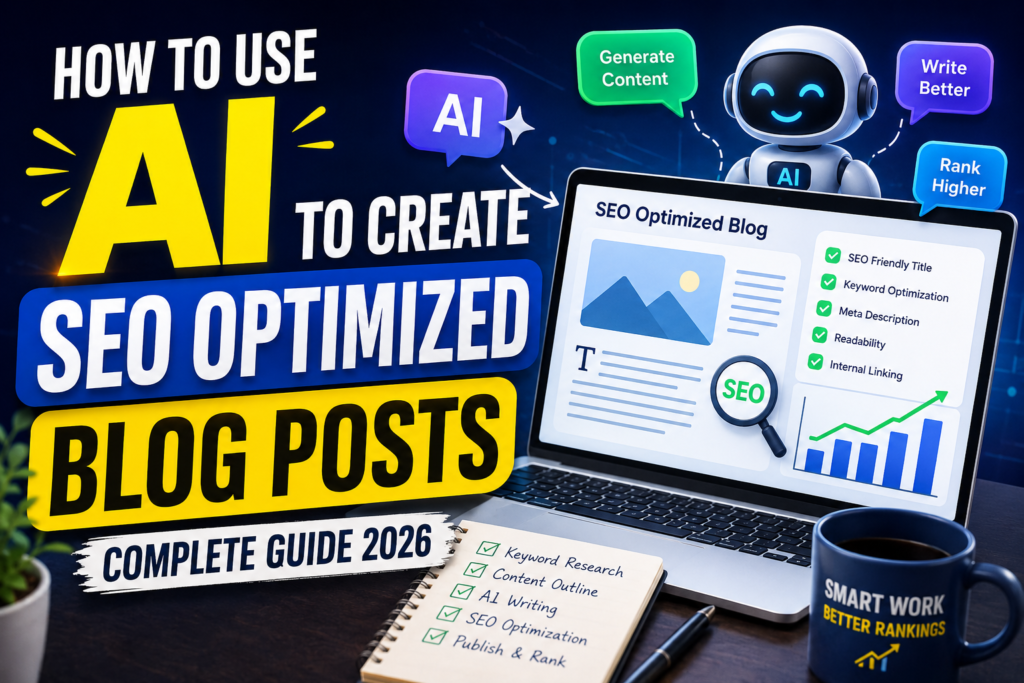
Artificial Intelligence (AI) has completely changed the way bloggers create content. A few years ago, writing a high-quality blog post required several hours of research, writing, editing, and SEO optimization. Today, AI tools can complete most of these tasks in a fraction of the time.
However, there is one important fact many beginners don’t understand.
AI alone doesn’t help you rank on Google.
Google rewards helpful, original, accurate, and user-focused content, not content that is simply generated by AI.
The secret is learning how to use AI correctly.
In this guide, you’ll learn the complete process of creating SEO optimized blog posts using AI while keeping the content natural, informative, and Google-friendly.
Table of Contents
- What is AI Blogging?
- Why AI is Changing SEO
- Benefits of Using AI for Blogging
- Best AI Tools for SEO Content
- Step-by-Step Guide to Create SEO Optimized Blogs with AI
- AI Prompt Examples
- Common Mistakes to Avoid
- Google Guidelines for AI Content
- Best Practices for AI SEO
- FAQs
- Conclusion
What is AI Blogging?
AI blogging means using Artificial Intelligence tools to assist in creating blog content. These tools help with:
- Topic research
- Keyword research
- Content outline
- Blog writing
- SEO optimization
- Grammar correction
- Readability improvement
- Meta descriptions
- FAQs
- Image ideas
AI acts as your writing assistant rather than replacing your expertise.
When combined with human editing and real experience, AI can help create content that is both useful for readers and optimized for search engines.
Why AI is Changing SEO Content Creation
Search Engine Optimization has evolved significantly.
Earlier, websites ranked simply by repeating keywords multiple times.
Now Google focuses on:
- Helpful content
- User experience
- Expertise
- Content quality
- Original information
- Search intent
- Readability
AI helps content creators save time while maintaining consistency and structure. Instead of spending hours on brainstorming, writers can focus on improving the quality and usefulness of their content.
Benefits of Using AI for SEO Blogging
1. Faster Content Creation
Instead of spending 6–8 hours writing a blog, AI can generate a structured draft within minutes.
This allows bloggers to publish more consistently without compromising quality.
2. Better Keyword Integration
AI naturally includes:
- Primary keywords
- Secondary keywords
- Long-tail keywords
- Related search terms
This improves topical relevance without excessive keyword repetition.
3. Improved Content Structure
AI automatically creates:
- Headings
- Subheadings
- Bullet points
- FAQs
- Tables (where relevant)
A well-structured article is easier for both readers and search engines to understand.
4. Saves Research Time
Modern AI tools summarize information from reliable sources, helping you understand a topic faster.
You should still verify facts before publishing.
5. Better Readability
AI improves:
- Sentence flow
- Grammar
- Paragraph length
- Simple language
- Clear explanations
This makes content suitable for a wider audience.
Best AI Tools for Creating SEO Optimized Blogs
1. ChatGPT
Best for:
- Blog writing
- SEO outlines
- Content ideas
- FAQs
- Content expansion
2. Google Gemini
Excellent for:
- Latest information
- Content planning
- Research assistance
- Summaries
3. Claude AI
Useful for:
- Long-form articles
- Editing
- Content polishing
- Improving readability
4. Surfer SEO
Best for:
- Content optimization
- Keyword suggestions
- SEO scoring
- Competitor analysis
5. Ahrefs
Ideal for:
- Keyword research
- Backlink analysis
- Competitor research
- Search volume analysis
6. Semrush
A complete SEO toolkit for:
- Keyword research
- Site audits
- Content marketing
- Rank tracking
Step 1: Start with Keyword Research
Keyword research is the foundation of every successful SEO blog.
Instead of choosing random topics, identify what your audience is searching for.
Example
Primary Keyword:
How to use AI to create SEO optimized blog
Secondary Keywords:
- AI blogging
- AI content writing
- AI SEO tools
- AI content optimization
- SEO blog writing
Long-Tail Keywords:
- How to write SEO articles using AI
- Best AI tools for SEO blogging
- AI prompts for blog writing
- Create blog posts with AI
- AI content writing for beginners
- AI SEO content strategy
LSI Keywords:
- Google ranking
- Search intent
- Content optimization
- AI writing assistant
- Organic traffic
- On-page SEO
- Blog writing tips
Step 2: Understand Search Intent
Before writing, ask:
Why is someone searching for this keyword?
For this topic, readers want:
- Step-by-step guidance
- AI tool recommendations
- SEO tips
- Practical examples
- Mistakes to avoid
When your content satisfies search intent, your chances of ranking improve significantly.
Step 3: Create a Detailed Outline with AI
Ask AI to generate an outline first instead of writing the full article immediately.
Example prompt:
Create a detailed SEO-friendly outline for the topic “How to use AI to create SEO optimized blog.” Include H2, H3 headings, FAQs, and beginner-friendly explanations.
A good outline keeps the article organized and ensures all important points are covered.
Step 4: Write Each Section Separately
Avoid generating the entire article in one prompt.
Instead, work section by section.
For example:
- Introduction
- Keyword research
- AI tools
- Writing process
- SEO optimization
- FAQs
- Conclusion
This approach improves quality and gives you better control over the final content.
Step 5: Add Human Experience
This is where many AI-generated blogs fail.
Don’t publish raw AI content.
Instead, add:
- Personal observations
- Practical examples
- Real workflows
- Lessons learned
- Industry experience
- Actionable tips
Readers trust authentic insights more than generic advice.
Step 6: Optimize On-Page SEO
Before publishing, ensure the following:
SEO Title
Include the primary keyword near the beginning.
Example:
How to Use AI to Create SEO Optimized Blog Posts (Complete Guide)
Meta Description
Write an engaging summary under 160 characters.
URL
Keep it short and keyword-rich.
Example:
/how-to-use-ai-to-create-seo-optimized-blog
Heading Structure
Use:
- H1
- H2
- H3
- H4 (if needed)
Maintain a logical hierarchy.
Internal Links
Link to related articles such as:
- Best AI Tools
- Keyword Research Guide
- On-Page SEO Checklist
- Content Marketing Tips
Internal linking improves user navigation and distributes SEO value across your website.
External Links
Reference authoritative sources when appropriate.
This helps build trust and credibility.
Step 7: Optimize Images
Every blog should include relevant images.
Use:
- Original graphics
- Screenshots
- Infographics
- AI-generated visuals (where appropriate)
Image SEO checklist:
- Descriptive file names
- Alt text with keywords
- Compressed image size
- WebP format if supported
Step 8: Improve Readability
Google values content that is easy to read.
Tips:
- Short paragraphs
- Simple language
- Bullet lists
- Numbered steps
- Clear headings
- Highlight important information
Aim for a conversational tone that feels natural to Indian readers.
AI Prompt Examples for Better Blog Writing
Prompt 1
Act as an SEO expert and create a detailed outline for the keyword “How to use AI to create SEO optimized blog.”
Prompt 2
Write a beginner-friendly article section with practical examples. Use natural English and avoid robotic language.
Prompt 3
Suggest semantic keywords, related keywords, FAQs, and internal linking ideas for this article.
Prompt 4
Rewrite this paragraph to improve readability without changing its meaning.
Common Mistakes to Avoid
Publishing Raw AI Content
Always review, edit, and personalize AI-generated text.
Keyword Stuffing
Using the same keyword repeatedly can harm readability and SEO.
Use natural variations instead.
Ignoring Search Intent
Don’t write what you want to say. Write what your audience wants to know.
Thin Content
A 500-word article rarely covers a competitive topic in depth.
Focus on comprehensive, valuable content.
No Internal Linking
Related articles help users explore more content and improve your site’s SEO.
Copying AI Output
Never copy content directly from AI without reviewing it. Add your own insights and ensure originality.
Google’s View on AI Content
Google does not penalize content simply because AI was used to create it.
What matters is whether the content is:
- Helpful
- Accurate
- Original
- Trustworthy
- Written for people first
- Demonstrates expertise
If AI helps you create better content for readers, it aligns with Google’s guidance.
Best Practices for AI SEO Blogging
- Start with keyword research.
- Understand search intent before writing.
- Create a structured outline.
- Write section by section.
- Add personal expertise and practical examples.
- Optimize titles, headings, and meta tags.
- Include internal and external links.
- Use optimized images with descriptive alt text.
- Proofread before publishing.
- Update older articles regularly to keep them relevant.
Frequently Asked Questions (FAQs)
Can AI-written blogs rank on Google?
Yes. AI-assisted blogs can rank well if they are original, helpful, accurate, and optimized for users rather than search engines alone.
Which AI tool is best for blogging?
ChatGPT is excellent for drafting and brainstorming, while tools like Surfer SEO, Ahrefs, and Semrush complement it with keyword research and optimization features.
Is AI content safe for SEO?
Yes, provided you review, edit, fact-check, and enhance it with your own expertise. Low-quality or spammy AI content is unlikely to perform well.
How long should an SEO blog be?
It depends on the topic. For competitive keywords, articles between 1,800 and 3,000 words often provide enough depth to satisfy user intent.
Can beginners use AI for blogging?
Absolutely. AI can simplify research, outlining, and drafting, making it easier for beginners to publish high-quality content while learning SEO fundamentals.
Conclusion:-
AI has become one of the most valuable tools for modern bloggers, but success doesn’t come from using AI alone. The real advantage lies in combining AI’s speed with human creativity, experience, and critical thinking.
A winning workflow starts with understanding your audience, researching the right keywords, creating a clear outline, and using AI to draft content efficiently. From there, your role is to refine the article, add unique insights, optimize it for SEO, and ensure it genuinely answers readers’ questions.
When you consistently publish well-structured, informative, and people-first content, AI becomes more than just a writing assistant—it becomes a productivity partner that helps you grow your website, attract organic traffic, and build long-term authority.
Whether you’re a beginner launching your first blog or an experienced content creator looking to scale, learning how to use AI responsibly will give you a significant edge in today’s competitive digital landscape.